[et_pb_section bb_built=”1″ admin_label=”section”][et_pb_row admin_label=”row”][et_pb_column type=”4_4″][et_pb_text admin_label=”Text” background_layout=”light” text_orientation=”left” use_border_color=”off” border_color=”#ffffff” border_style=”solid”]
Consider going rock climbing this summer while the weather’s still warm. Rock climbing is gaining in popularity with more than 9 million current active rock climbers in the U.S. alone. It’s a holistically superior alternative to aerobic exercise due to its efficient calorie-burning, strength-building, and social bonding benefits. It also sharpens your mind while you exercise. Unbeknown to many, rock climbing is an entry-level activity – physically fit or not, anyone can start doing it!
Rock climbing doesn’t require superior upper body strength. Surprisingly, a sharp mind is far more necessary than buff upper arms. Your decisive footholds and overall technique are what determine how successful of a rock climber you are. Unlike monotonous treadmill running or weight lifting, rock climbing challenges your mind.
Rock climbing forces you to keep your attention sharp since you must routinely plan two moves ahead before even physically securing your next position. You’re constantly trying to figure out which subsequent grabs and footholds will lead you to an overall efficient path to the top, so you’re constantly exercising your problem-solving neural pathways. Since your mind is distracted throughout the workout, exercising becomes more enjoyable and challenging.
Just like most exercises, rock climbing reduces stress. Moreover, research shows that if you’re a frequent rock climber, you’ll have more positive moods overall and instances of depression will decrease. And if that’s not enough, research also shows that rock climbing can be a natural painkiller if you lose yourself to the flow – in these moments, any pain is blocked, replaced by euphoria.
Unlike most exercises, rock climbing improves your self-esteem, motivation, and self-confidence. Professional rock climbers testify that the activity empowers them by forcing them to overcome their fears. Who wouldn’t feel a sense of great achievement when they get to the top of a 1,000-foot tall cliff?
Now as far as physical benefits go, rock climbing is actually more efficient at losing weight and toning your muscles than most other exercises. Studies show that rock climbing is equivalent to running at approximately 7.5 miles per hour or taking 244 steps per minute. On average, a 155-pound person burns approximately 350 calories each half hour of rock climbing. These numbers only increase depending on your climbing speed and the difficulty of the terrain involved. In fact, if you climb continuously, taking few breaks, rock climbing becomes a full body aerobic workout.
Rock climbing also strengthens and tones diverse groups of your muscles. Most of your major muscles (legs, back, shoulders, forearms) are being used when you balance and commandeer your next positions, so their endurance and strength are improved. Besides better muscle definition, frequent rock climbers have low body fat percentages, low body mass indices, and improved handgrip strengths. Rock climbing also improves your flexibility and bendability, making you more agile.
Best of all, according to the CDC, you only need about one or two-and-a-half hours each week of rock climbing to significantly reduce your risk of developing hypertension, diabetes, and cardiovascular diseases.
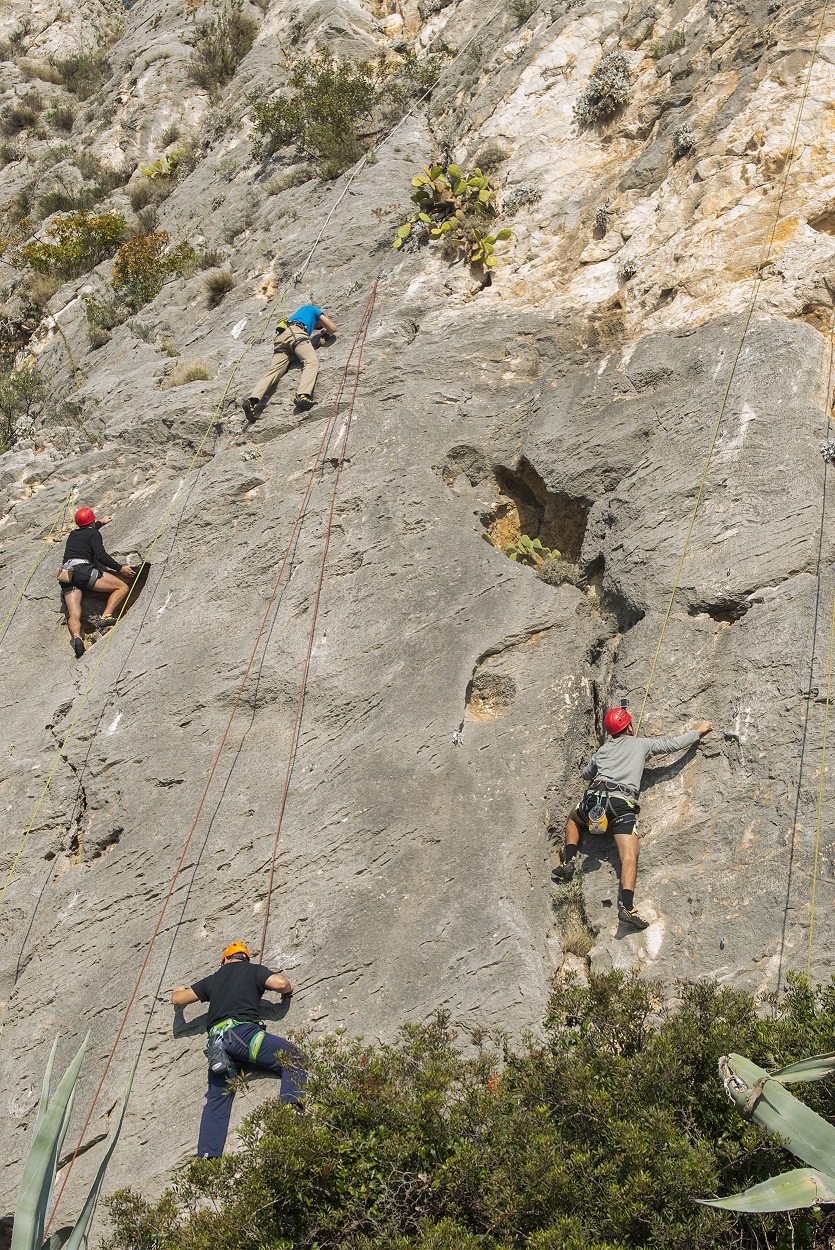
Unlike most aerobic or strength-building exercises, rock climbing isn’t solo! Although not required, you’d be crazy not to have a belayer, who supports and manages your ropework while you climb, since they make sure you’re okay and literally won’t leave you hanging in case you get into trouble. Most indoor gym rock climbers belay each other, creating special social bonds since you’re all placing your safety in each other’s hands. Since you’re all rock climbers, you can exchange techniques and routes to the top, as well as share ideas.
[/et_pb_text][et_pb_image admin_label=”Image” src=”http://medhealthnews.com/wp-content/uploads/2016/01/rockclimbing1.jpg” alt=”Belayers” title_text=”Belayers” show_in_lightbox=”off” url_new_window=”off” use_overlay=”off” animation=”off” sticky=”off” align=”left” force_fullwidth=”off” always_center_on_mobile=”on” use_border_color=”off” border_color=”#ffffff” border_style=”solid” custom_margin=”||0px|” /][et_pb_text admin_label=”Text” background_layout=”light” text_orientation=”left” text_font=”||on||” text_font_size=”10″ use_border_color=”off” border_color=”#ffffff” border_style=”solid” custom_margin=”0px|||” custom_padding=”0px|||”]
Belayers share special bonds.
[/et_pb_text][et_pb_text admin_label=”Text” background_layout=”light” text_orientation=”left” use_border_color=”off” border_color=”#ffffff” border_style=”solid”]
If you’re a busy corporate person, or just hate exercising – rock climbing is right up your alley. It’s a complete cardio and strength and endurance workout! It also sharpens your mind and keeps the boredom and monotony away so you won’t feel the burn. Take off your coat and tie and spend just a little over two hours a week scaling rocks, and you’ll have a better looking bod and a healthier heart. And while rock climbing, you can network with others while doing your workout, possibly meeting potential business partners and great friends!
[/et_pb_text][/et_pb_column][/et_pb_row][/et_pb_section]